
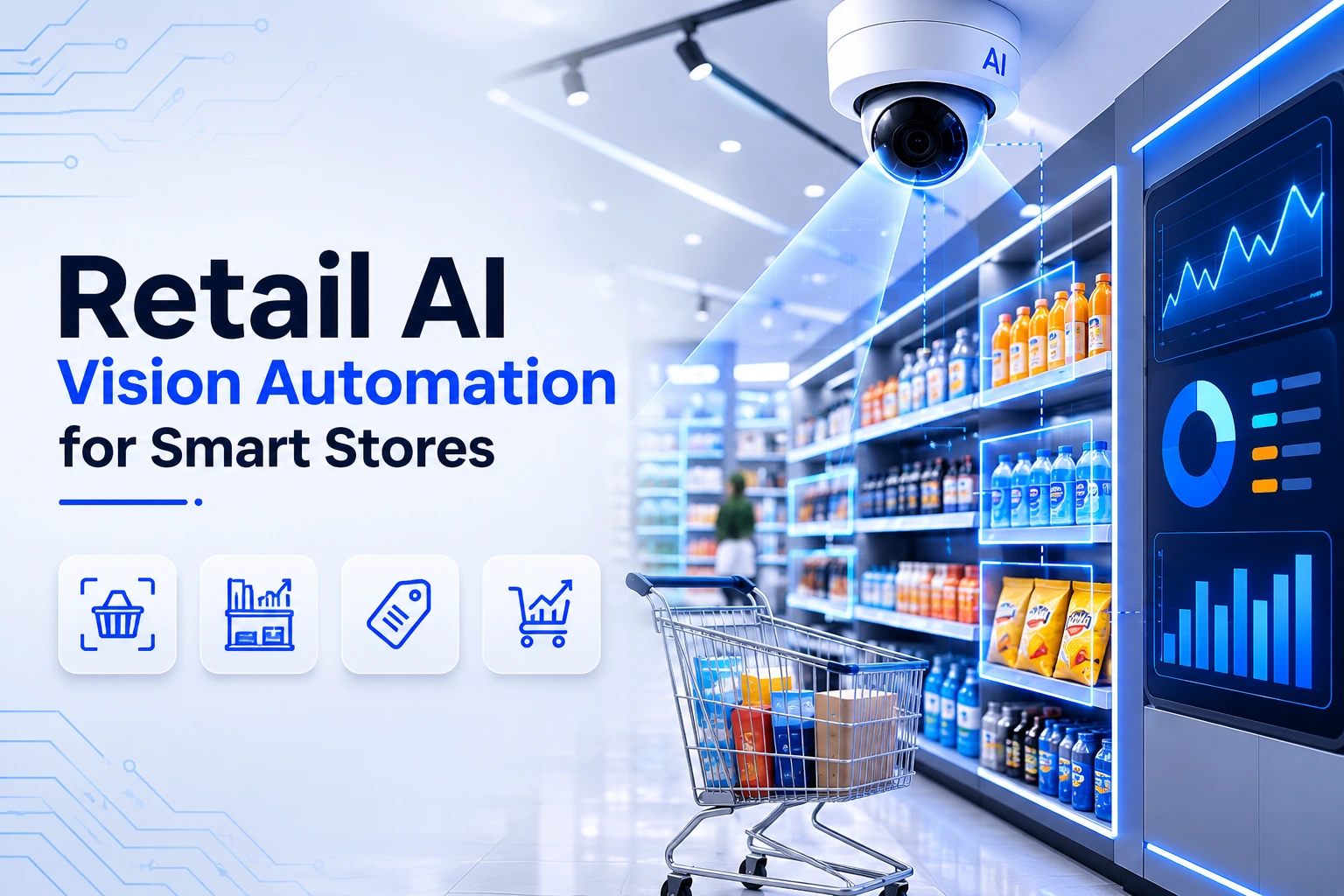
Retailers are under constant pressure to improve efficiency, reduce losses, and deliver faster shopping experiences. Retail AI vision automation helps solve these challenges by combining computer vision and AI to automate checkout, monitor inventory, prevent theft, and optimize store operations. This guide explores how the technology works, its top use cases, and the leading enterprise platforms in 2026.
What Is Retail AI Vision Automation?
Retail AI vision automation combines computer vision, artificial intelligence, and smart cameras to automate everyday retail operations. Instead of relying solely on employees to monitor shelves, checkout lanes, and customer activity, AI continuously analyzes visual data to detect events, identify patterns, and trigger actions in real time.
As retailers face rising labor costs, inventory challenges, and increasing customer expectations, AI vision has become a practical solution for improving efficiency while delivering a better shopping experience.
Understanding AI Vision in Retail
AI vision in retail uses cameras and machine learning models to interpret what happens inside a store. Rather than simply recording video, the system understands objects, products, shopping carts, customer movement, and employee activities.
For example, AI can recognize when a shelf is nearly empty, detect products placed in the wrong location, or identify when a shopper removes an item from a shelf. These insights help retailers make faster operational decisions without manually reviewing hours of video footage.
How Computer Vision Transforms Store Operations
Traditional retail operations depend heavily on manual inspections and employee observations. Computer vision changes this approach by monitoring store activity continuously and providing actionable insights.
Instead of waiting for employees to discover empty shelves or checkout issues, AI immediately identifies operational problems and sends alerts to the appropriate staff. This enables stores to restock products faster, reduce customer wait times, and maintain better inventory accuracy.
Computer vision also supports data-driven decision-making by collecting valuable information about customer behavior, store performance, and operational efficiency.
Why Retailers Are Investing in AI Vision
Retailers are investing in AI vision because it addresses several costly operational challenges at once.
Some of the biggest benefits include:
- Faster and more convenient checkout experiences.
- Better inventory visibility across the store.
- Reduced product shrinkage and theft.
- Improved labor efficiency.
- Higher product availability.
- Better customer experience through data-driven store optimization.
As AI technology becomes more accurate and affordable, many enterprise retailers now consider computer vision a strategic investment rather than an experimental technology.
How Retail AI Vision Automation Works
Retail AI vision automation combines hardware and software to monitor store activity, analyze visual information, and automate operational workflows. The system continuously captures images, processes them using AI models, and delivers insights that help retailers respond quickly to changing conditions.
This allows stores to move from reactive operations to real-time decision-making.
Cameras, Sensors, and AI Models
The foundation of every AI vision system is a network of cameras positioned throughout the store. Depending on the deployment, retailers may also use shelf sensors, smart checkout devices, weight sensors, or edge computing hardware.
These devices collect visual data that AI models analyze using computer vision techniques such as object detection, product recognition, people tracking, and activity analysis.
Modern AI models are trained to recognize thousands of different products, monitor shelf conditions, and identify customer interactions with high accuracy.
Real-Time Image Analysis
Once images are captured, AI processes them almost instantly. Instead of storing video for later review, the system analyzes events as they happen.
For example, AI can detect when products are running low, identify unusually long checkout lines, recognize non-scan events at self-checkout stations, or measure customer traffic throughout the store.
Real-time analysis enables employees to respond immediately rather than discovering problems hours later.
From Detection to Automated Actions
The true value of retail AI vision automation comes from turning insights into action.
After detecting an event, AI can automatically trigger predefined workflows such as:
- Sending restocking alerts to store associates.
- Notifying managers about suspicious activity.
- Updating inventory systems.
- Opening additional checkout lanes.
- Generating operational reports.
- Creating tasks within retail management software.
Instead of simply reporting issues, AI helps retailers resolve them faster while reducing manual work across daily operations.
Key Use Cases of Retail AI Vision Automation
Retail AI vision automation supports multiple business functions across modern stores. Rather than focusing on a single process, computer vision improves customer experience, inventory management, operational efficiency, and loss prevention simultaneously.
Autonomous Checkout
One of the most recognized applications of AI vision is autonomous checkout. Using ceiling-mounted cameras and computer vision algorithms, the system tracks which products customers select and automatically creates a virtual shopping cart.
When shoppers leave the store, payment is processed without scanning individual products or waiting in line. This approach significantly reduces checkout times while improving convenience for customers and lowering operational costs for retailers.
Shelf Intelligence and Inventory Monitoring
Keeping shelves fully stocked is essential for maximizing sales. AI-powered shelf monitoring continuously scans product displays to identify empty spaces, misplaced items, incorrect pricing, and planogram compliance issues.
Instead of relying on scheduled inspections, store associates receive immediate notifications when products need replenishment. This helps reduce out-of-stock situations, improves inventory accuracy, and ensures customers can find the products they need.
AI-Powered Loss Prevention
Retail shrinkage remains a major challenge for enterprise retailers. AI vision systems help reduce losses by monitoring checkout areas and identifying suspicious behavior in real time.
Computer vision can detect events such as items that are not scanned during self-checkout, unusual shopping patterns, or behaviors that may indicate theft. Rather than replacing security personnel, AI provides additional visibility that allows teams to investigate incidents more efficiently while minimizing false alarms.
Customer Traffic Analytics and Heatmaps
AI vision also provides valuable insights into how customers move throughout the store. By analyzing anonymous traffic patterns, retailers can identify high-traffic areas, popular product displays, and locations where customers spend the most time.
Heatmaps help retailers optimize store layouts, improve product placement, reduce congestion, and design shopping experiences that encourage higher engagement and increased sales.
Leading Retail AI Vision Automation Platforms in 2026
Several technology providers now offer enterprise-grade computer vision solutions specifically designed for retail environments. While their approaches differ, they all aim to improve operational efficiency through AI-powered visual intelligence.
| Platform | Primary Use Case | AI Vision Capability | Business Value |
|---|---|---|---|
| AiFi | Autonomous checkout | Ceiling-mounted computer vision that tracks customer movement and product selection | Faster checkout and reduced labor costs |
| Focal Systems | Shelf intelligence | AI-powered shelf monitoring with real-time inventory detection | Fewer out-of-stock events and improved inventory accuracy |
| Everseen | Loss prevention | Computer vision that detects non-scan events and checkout anomalies | Lower retail shrinkage and improved self-checkout security |
AiFi specializes in autonomous shopping experiences by using computer vision to eliminate traditional checkout lines. Its technology enables customers to enter a store, select products, and leave without scanning items individually, creating a faster and more convenient shopping journey.
Focal Systems focuses on shelf intelligence and inventory automation. Its AI continuously monitors store shelves, helping retailers identify empty spaces, misplaced products, and replenishment needs before they impact sales.
Everseen applies computer vision to loss prevention and checkout monitoring. By analyzing activity at point-of-sale and self-checkout stations, the platform helps retailers detect non-scan events and reduce shrinkage while maintaining a smooth customer experience.
Benefits of AI Vision for Retail Operations
For retail executives, investing in retail AI vision automation is not just about adopting new technology. It is about improving operational efficiency, reducing costs, and delivering measurable business results. When implemented effectively, AI vision helps retailers streamline daily operations while increasing customer satisfaction and profitability.
Faster Customer Experiences
Modern shoppers expect speed and convenience. AI vision technologies reduce waiting times by supporting autonomous checkout, monitoring queue lengths, and helping staff respond quickly during busy periods.
Customers benefit from shorter checkout lines, faster assistance, and a smoother in-store experience. At the same time, store employees can focus on customer service instead of repetitive operational tasks.
Improved Inventory Accuracy
Inventory errors can lead to lost sales and dissatisfied customers. AI vision continuously monitors shelves to identify out-of-stock products, misplaced items, and pricing inconsistencies in real time.
By providing accurate inventory insights, retailers can replenish products more efficiently, improve product availability, and reduce the risk of empty shelves during peak shopping hours.
Reduced Operational Costs
Retail AI vision automation helps lower operating expenses by automating repetitive monitoring tasks and improving workforce efficiency. Instead of performing frequent manual inspections, employees receive alerts only when action is required.
This approach reduces labor costs, minimizes inventory losses, and improves overall store productivity. Over time, these operational improvements contribute to a stronger return on investment (ROI) and better business performance.
Challenges and Considerations Before Deployment
Although AI vision offers significant benefits, successful implementation requires careful planning. Retailers should evaluate technical, operational, and regulatory factors before deploying AI vision across multiple locations.
Privacy and Compliance
Retail AI systems often process video data collected inside stores. Organizations must ensure that data collection complies with applicable privacy regulations and company policies.
Retailers should also be transparent about camera usage, protect customer information, and implement appropriate security controls to maintain trust while meeting legal requirements.
Integration With Existing Retail Systems
AI vision delivers the greatest value when it works seamlessly with existing business systems such as inventory management software, point-of-sale (POS) platforms, enterprise resource planning (ERP) systems, and analytics tools.
Before selecting a solution, retailers should evaluate available integrations, API support, and compatibility with their current technology stack to avoid costly implementation challenges.
AI Accuracy and Ongoing Maintenance
Computer vision models require continuous monitoring and periodic updates to maintain high accuracy. Changes in store layouts, lighting conditions, seasonal displays, and product packaging can affect system performance.
Retailers should work with vendors that provide ongoing model improvements, regular software updates, and technical support to ensure long-term reliability.
How to Choose the Right Retail AI Vision Solution
Choosing the right AI vision platform requires more than comparing feature lists. Retail organizations should evaluate how well each solution supports their business objectives, existing infrastructure, and future growth plans.
Evaluate Your Retail Environment
Every retailer has different operational needs. Grocery stores, convenience stores, fashion retailers, and warehouse clubs all face unique challenges that require different AI capabilities.
Start by identifying your biggest operational priorities, whether they involve reducing checkout times, improving inventory visibility, preventing losses, or optimizing store layouts.
Compare Deployment Models
Some AI vision platforms process data on local edge devices, while others rely on cloud infrastructure or hybrid deployments. Each approach offers different advantages related to performance, scalability, latency, and infrastructure requirements.
Choose a deployment model that aligns with your organization’s security policies, network architecture, and operational goals.
Measure Long-Term ROI
The most successful AI projects deliver measurable business outcomes over time. Retailers should evaluate key performance indicators such as reduced shrinkage, improved inventory availability, faster checkout times, lower labor costs, and higher customer satisfaction.
Large retailers investing in AI often extend automation beyond store operations. If your organization also manages complex IT infrastructure, our guide to Best AI Platforms for Automating NOC Workflows explains how AI can improve network operations alongside retail automation.
Final Thoughts
Retail AI vision automation is helping retailers transform stores into smarter, more efficient environments by improving inventory management, customer experiences, and operational visibility. However, the right solution depends on your business goals, store network, and existing technology ecosystem. By selecting a platform that aligns with your operational needs, you can maximize long-term ROI while building a more intelligent retail operation.
