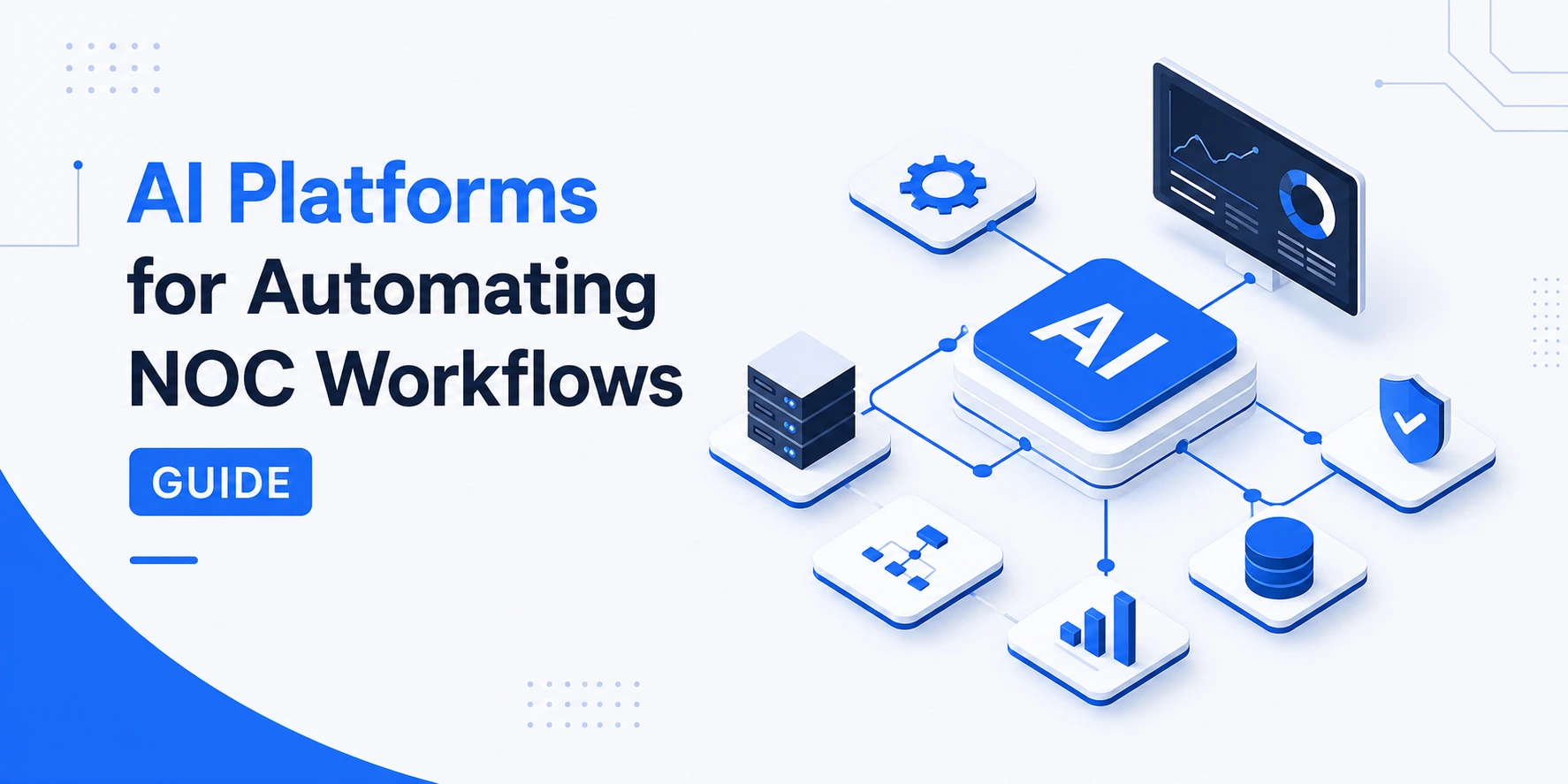
Managing thousands of daily alerts is no longer sustainable for modern enterprise IT teams. The best AI platforms for automating NOC workflows use intelligent automation to reduce alert noise, identify root causes faster, and streamline incident response. This guide explores the leading AI solutions for NOC, SOC, and security workflow automation in 2026.
Why Traditional NOC Workflows Can No Longer Keep Up
Modern enterprise networks generate far more data than traditional Network Operations Centers (NOCs) were designed to handle. Cloud services, hybrid infrastructure, IoT devices, and distributed applications produce thousands of events every minute. As a result, IT teams often spend more time sorting alerts than solving actual problems.
This is why many organizations are replacing manual monitoring with AI platforms for automating NOC workflows. These platforms use artificial intelligence to reduce unnecessary alerts, identify the root cause of incidents, and automate repetitive operational tasks. The goal is not to replace engineers but to help them focus on the issues that truly require human expertise.
The Growing Alert Fatigue Problem
One of the biggest challenges for NOC teams is alert fatigue. Monitoring tools can generate thousands of notifications every day, but many of them are duplicates, low priority, or triggered by the same underlying issue. Engineers must review each alert, making it difficult to quickly identify incidents that have a real business impact.
As the number of cloud applications, network devices, and connected services continues to grow, this problem becomes even more serious. Critical alerts may be overlooked simply because teams are overwhelmed by the volume of notifications.
AI-powered AIOps platforms address this challenge by analyzing relationships between alerts, grouping related events into a single incident, and filtering out unnecessary noise. Instead of responding to hundreds of separate notifications, engineers can investigate one prioritized incident with clear context and recommended next steps.
Why Manual Incident Response Slows IT Teams
Traditional incident management often depends on manual investigation. After receiving an alert, engineers need to collect logs, check dashboards, compare system metrics, and communicate with different teams before identifying the root cause.
This process can take hours, especially in large enterprise environments where applications, servers, and cloud services are closely connected. Longer investigations increase downtime, affect business operations, and place additional pressure on IT staff.
AI changes this workflow by continuously analyzing operational data from multiple sources. It can detect patterns, correlate events across different systems, and highlight the most likely cause of an incident within seconds. Many platforms also recommend remediation steps or automatically trigger predefined workflows, allowing engineers to resolve issues much faster.
What Enterprises Expect From AI Today
Enterprise IT leaders are no longer looking for tools that simply collect monitoring data. They expect AI to become an active part of daily operations by helping teams make faster and more accurate decisions.
Today, organizations typically look for AI platforms that can:
- Reduce alert noise without hiding important incidents.
- Identify root causes across complex hybrid and multi-cloud environments.
- Prioritize incidents based on business impact.
- Recommend or automate remediation using predefined workflows.
- Learn from historical operational data to improve future incident handling.
These capabilities allow NOC teams to spend less time reacting to alerts and more time improving service reliability, reducing downtime, and supporting business growth.
What Are AI Platforms for Automating NOC Workflows?
AI platforms for automating NOC workflows are enterprise solutions that combine artificial intelligence, machine learning, and automation to improve how IT operations teams monitor, investigate, and resolve network and infrastructure issues. Most modern platforms are built on AIOps (Artificial Intelligence for IT Operations) principles, allowing them to process massive amounts of operational data much faster than traditional monitoring tools.
Instead of asking engineers to manually review thousands of events, these platforms continuously analyze metrics, logs, traces, and alerts to detect meaningful patterns. They can identify abnormal behavior, connect related events, and recommend the most effective response before small issues become major outages.
How AI-Driven AIOps Platforms Work
AIOps platforms collect operational data from many sources, including network devices, cloud services, applications, servers, and monitoring systems. AI models then analyze this information in real time to understand how different events are connected.
Rather than treating every alert as an independent problem, the platform groups related alerts into a single incident. It also evaluates historical data, identifies recurring patterns, and predicts potential failures before users experience service disruptions.
Many enterprise platforms also integrate with IT service management (ITSM) tools and automation systems. This allows AI to trigger predefined workflows, assign incidents to the right teams, or even start automated remediation processes without waiting for manual intervention.
Core Capabilities Every Enterprise Should Expect
Although features vary between vendors, leading enterprise AI platforms typically provide several core capabilities.
- Intelligent alert correlation to eliminate duplicate notifications.
- Root cause analysis that identifies the most likely source of an incident.
- Anomaly detection using machine learning instead of static thresholds.
- Predictive analytics to identify potential problems before they affect services.
- Automated incident prioritization based on business impact.
- Workflow automation for common operational tasks.
- Integration with cloud platforms, observability tools, and ITSM solutions.
Together, these capabilities help IT teams manage increasingly complex environments while improving operational efficiency.
Benefits Beyond Simple Monitoring
Traditional monitoring tools tell engineers when something goes wrong. AI-powered platforms go much further by helping teams understand why the problem happened and how to resolve it.
This shift delivers several important business benefits:
- Faster incident detection and response.
- Reduced alert fatigue for NOC engineers.
- Shorter mean time to detect (MTTD) and mean time to resolve (MTTR).
- Better visibility across hybrid and multi-cloud environments.
- More consistent operations through automated workflows.
- Improved service availability and customer experience.
For large enterprises, these improvements can significantly reduce operational costs while allowing IT teams to focus on strategic initiatives instead of repetitive troubleshooting.
Best AI Platforms for Automating NOC Workflows in 2026
Several enterprise vendors now offer AI-powered platforms designed to simplify NOC operations. While each solution has its own strengths, the best platforms focus on reducing alert noise, accelerating root cause analysis, and automating incident response at scale.
The following solutions are among the leading options for enterprise IT operations in 2026.
| Platform | Best For | Key AI Capabilities | Ideal Enterprise Use Case |
|---|---|---|---|
| Cisco AgenticOps | Large Cisco environments | AI agents, workflow automation, root cause analysis | Organizations running extensive Cisco infrastructure |
| Dynatrace Davis AI | Full-stack observability | Causal AI, anomaly detection, predictive insights | Hybrid and multi-cloud environments |
| BigPanda | Event correlation | Alert deduplication, incident clustering, noise reduction | Enterprises managing large volumes of monitoring alerts |
| Splunk ITSI | IT service intelligence | Service health monitoring, event analytics, AI-assisted investigations | Organizations already using the Splunk ecosystem |
| sauble.ai | AI-assisted IT operations | Intelligent automation and operational insights | Teams looking to streamline repetitive NOC workflows |
Cisco AgenticOps
Cisco AgenticOps extends traditional network management by using AI agents that help identify operational issues, recommend corrective actions, and automate routine tasks. The platform is designed to improve operational efficiency while giving engineers greater visibility across complex enterprise networks.
Dynatrace Davis AI
Dynatrace Davis AI combines observability with causal AI to analyze application performance, infrastructure health, and cloud services in real time. Instead of simply detecting anomalies, it explains why problems occur, helping teams reduce investigation time and improve incident resolution.
BigPanda
BigPanda focuses on one of the largest operational challenges in enterprise IT: alert overload. Its AI engine correlates thousands of alerts from different monitoring tools into a smaller number of meaningful incidents, making it easier for engineers to prioritize and resolve issues.
Splunk ITSI
Splunk IT Service Intelligence (ITSI) enhances operational visibility by combining monitoring data with AI-driven analytics. The platform helps organizations understand service health, detect abnormal behavior, and prioritize incidents based on their potential business impact.
sauble.ai
sauble.ai focuses on applying AI to streamline operational workflows and reduce manual effort across IT operations. By automating repetitive tasks and supporting faster incident investigation, it helps NOC teams improve efficiency while maintaining service reliability.
How AI SOC Automation Complements Modern NOC Operations
While NOC teams focus on network performance and service availability, Security Operations Centers (SOCs) are responsible for detecting and responding to cyber threats. As enterprise environments become more connected, these two teams often work together to investigate incidents that affect both operations and security.
This is why AI SOC automation has become an important complement to AI-powered NOC workflows. By automating repetitive security tasks, organizations can reduce response times, improve threat detection, and allow analysts to focus on high-risk incidents.
The Difference Between NOC and SOC Automation
Although they share similar technologies, NOC and SOC automation serve different purposes.
NOC automation focuses on maintaining system availability. AI analyzes infrastructure data, identifies performance issues, correlates operational alerts, and helps restore services quickly.
SOC automation, on the other hand, focuses on cybersecurity. AI analyzes security logs, detects suspicious behavior, prioritizes threats, and supports incident response before attackers can cause significant damage.
Many enterprises now integrate both environments so operational and security teams can share data, improve visibility, and respond to incidents more efficiently.
AI Agents for Threat Investigation
Modern SOC platforms increasingly use AI agents to accelerate threat investigations. Instead of requiring analysts to manually collect information from multiple security tools, AI agents automatically gather logs, review endpoint activity, analyze user behavior, and build a timeline of suspicious events.
This automation significantly reduces investigation time while ensuring analysts receive the context needed to make informed decisions. Some platforms can also recommend response actions or trigger predefined playbooks that isolate compromised devices, disable user accounts, or notify the appropriate security teams.
By reducing repetitive investigative work, AI helps SOC analysts spend more time on complex threats that require human expertise.
Popular SOC Automation Platforms
Several enterprise platforms now combine AI with security orchestration, automation, and response (SOAR) capabilities.
- Splunk SOAR helps automate incident response by connecting security tools and executing response playbooks from a centralized platform.
- Palo Alto Cortex XSOAR combines case management, orchestration, and AI-assisted workflows to improve security operations at scale.
- Microsoft Sentinel uses cloud-native AI and advanced analytics to detect threats across hybrid and multi-cloud environments.
- Torq focuses on AI-driven workflow automation that simplifies security operations without requiring extensive coding.
- Tines enables security teams to automate repetitive processes through flexible workflows that integrate with hundreds of enterprise tools.
Together, these platforms help organizations reduce analyst workload, shorten response times, and improve the consistency of security operations.
AI for Automating Security Questionnaires
Completing security questionnaires is one of the most time-consuming tasks for enterprise software vendors. Large customers often require detailed assessments covering security controls, compliance certifications, privacy practices, and infrastructure before approving a purchase.
Finding the top AI powered tool to automate security questionnaires has therefore become a priority for many security, compliance, and sales teams looking to accelerate enterprise deals.
Why Security Questionnaires Delay Enterprise Deals
Enterprise security questionnaires may contain hundreds of detailed questions related to frameworks such as SOC 2, ISO 27001, HIPAA, or internal customer requirements.
Answering these questionnaires often requires input from security engineers, compliance specialists, legal teams, and product managers. Without automation, the process can take days or even weeks, delaying procurement and increasing the workload for multiple departments.
As organizations receive more requests from enterprise customers, manually completing questionnaires becomes difficult to scale.
How AI Completes Questionnaires Automatically
Modern AI platforms reduce this workload by creating a centralized knowledge base from existing security documentation, policies, previous questionnaire responses, and compliance reports.
When a new questionnaire arrives, AI analyzes each question, searches the organization’s approved content, and suggests accurate answers automatically. Many platforms also highlight confidence scores, allowing experts to review responses before submission.
Some solutions support browser extensions and customer portals, enabling teams to complete questionnaires directly within procurement platforms while maintaining consistent answers across every submission.
Leading Tools in 2026
Several AI-powered platforms specialize in automating security questionnaires for enterprise sales and compliance teams.
- Wolfia uses AI to generate questionnaire responses from an organization’s existing security documentation.
- Conveyor automates customer security reviews by providing AI-assisted answers and secure document sharing.
- SecurityPal combines AI with human validation to help organizations complete complex enterprise security assessments more efficiently.
- Loopio supports proposal and questionnaire automation through centralized content management and AI-assisted response generation.
These platforms help organizations reduce manual work, improve response consistency, and shorten the time required to complete customer security reviews.
How to Choose the Right AI Automation Platform
Selecting the right AI platform involves more than comparing features. Enterprise organizations should evaluate how well a solution fits their existing infrastructure, security requirements, and long-term operational goals.
Integration Requirements
A strong AI platform should integrate easily with existing monitoring tools, cloud providers, IT service management systems, collaboration platforms, and security solutions.
The more data AI can analyze from across the environment, the more accurate its insights and recommendations become. Organizations should also consider API availability, supported integrations, and deployment flexibility before making a decision.
AI Accuracy and Explainability
AI recommendations should be transparent rather than acting as a “black box.” Engineers need to understand why a platform identified an incident, prioritized a threat, or suggested a specific remediation step.
Platforms that provide explainable AI help teams build trust in automated decisions while making it easier to validate recommendations during critical incidents.
Scalability and Security
Enterprise environments continue to grow in size and complexity. The chosen platform should scale across hybrid infrastructure, cloud services, containers, and distributed applications without reducing performance.
Security is equally important. Look for platforms that offer strong access controls, encryption, audit logging, compliance support, and governance features that align with your organization’s security policies.
Comparison Table: Enterprise AI Automation Solutions (2026)
| Category | Main Problem | How AI Helps | Leading Platforms |
|---|---|---|---|
| NOC Workflows (AIOps) | Engineers spend too much time managing thousands of operational alerts. | Correlates alerts, identifies root causes, predicts failures, and automates remediation workflows. | Cisco AgenticOps, Dynatrace Davis AI, BigPanda, Splunk ITSI, sauble.ai |
| SOC Automation (SOAR) | Security analysts face alert overload and slow incident response. | Prioritizes threats, automates investigations, launches response playbooks, and reduces manual work. | Splunk SOAR, Cortex XSOAR, Microsoft Sentinel, Torq, Tines |
| Security Questionnaires | Enterprise sales slow down because security assessments require extensive manual effort. | Uses AI to answer questionnaires from approved documentation while maintaining consistency and accuracy. | Wolfia, Conveyor, SecurityPal, Loopio |
Final Thoughts
AI is transforming enterprise operations by reducing manual work across network management, cybersecurity, and compliance processes. Instead of treating NOC, SOC, and security questionnaires as separate challenges, many organizations now view them as connected workflows that benefit from intelligent automation.
The best platform is not necessarily the one with the most features. It is the one that integrates with your existing environment, supports your operational goals, and helps your teams respond faster without sacrificing accuracy or security. By carefully evaluating your organization’s needs, you can choose an AI solution that improves efficiency today while supporting future growth.
