
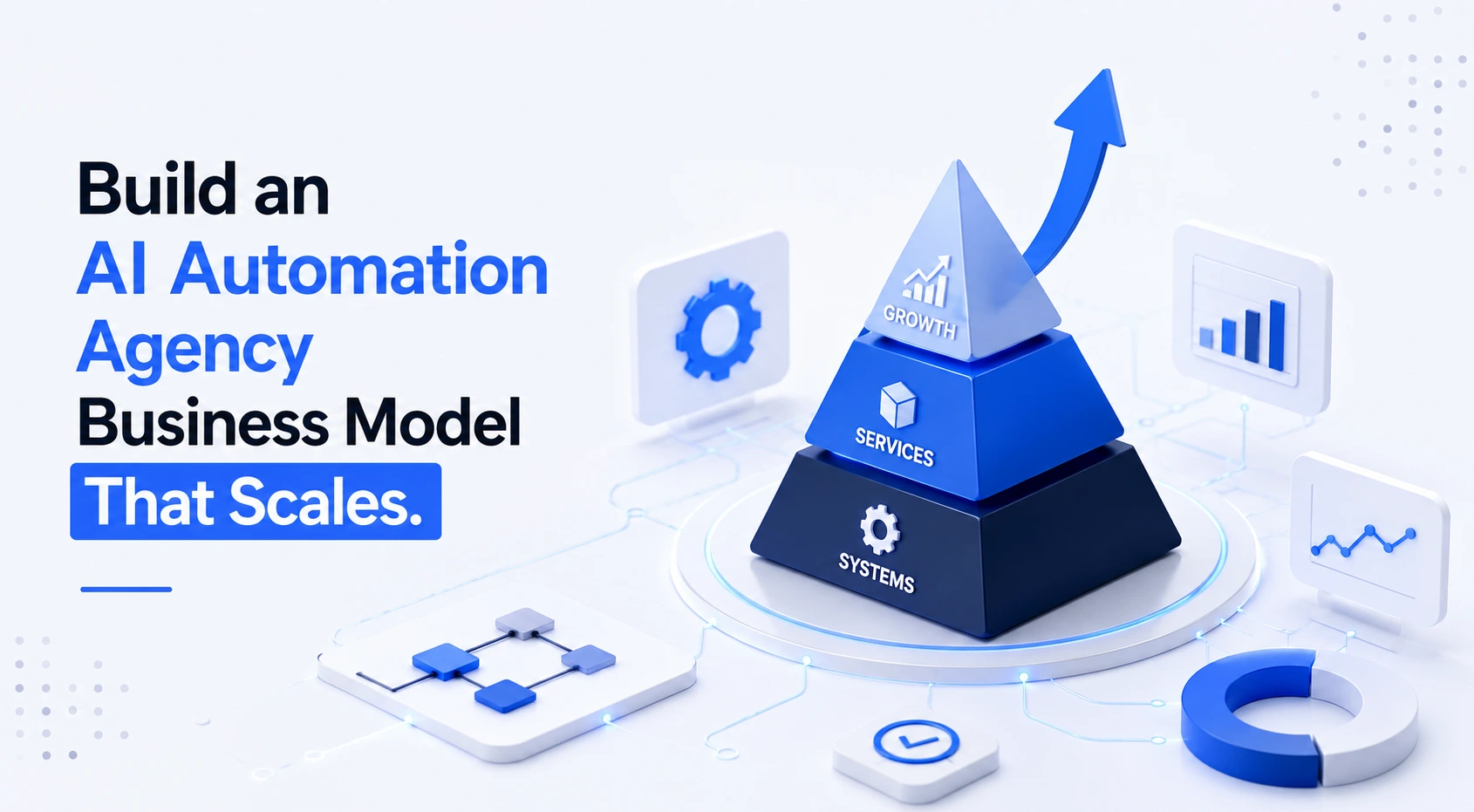
Starting an AI automation agency business model is one of the fastest-growing opportunities in the AI economy, but success requires more than technical skills. You need the right niche, pricing strategy, and scalable service offerings to build a profitable agency. This guide explains how to structure your business model, price your services, and create recurring revenue in 2026.
What Is an AI Automation Agency Business Model?
An AI automation agency business model defines how an agency creates, delivers, and monetizes AI-powered automation services for businesses. Instead of selling software licenses, these agencies help organizations identify repetitive processes, implement AI solutions, integrate business systems, and provide ongoing optimization. Their goal is to improve efficiency, reduce manual work, and generate measurable business outcomes.
As AI adoption continues to accelerate across industries, demand has shifted from standalone AI tools to complete implementation services. Many companies recognize the potential of AI but lack the internal expertise to deploy automation successfully. This creates opportunities for agencies that can combine strategic consulting, workflow design, AI integration, and long-term support into a scalable service offering.
What an AI Automation Agency Does
An AI automation agency works with businesses to analyze existing workflows and identify tasks that can be automated using AI and modern automation platforms. Typical engagements include designing workflows, connecting business applications through APIs, deploying AI-powered assistants, and monitoring performance after implementation.
Depending on the client’s needs, an agency may automate customer support, finance, sales operations, marketing workflows, internal approvals, or document processing. Rather than replacing employees, these solutions are designed to eliminate repetitive tasks so teams can focus on higher-value work.
Why the AI Automation Market Is Growing
The market for AI automation services is expanding because organizations are under increasing pressure to improve productivity while controlling operational costs. Advances in generative AI, workflow automation platforms, and API integrations have made enterprise-grade automation more accessible to businesses of all sizes.
At the same time, companies are looking for partners who can implement AI responsibly, integrate it with existing systems, and deliver measurable ROI without disrupting daily operations. This growing demand has made AI automation agencies an attractive business model for consultants, developers, and digital service providers.
Who Should Start an AI Automation Agency
An AI automation agency can be a strong opportunity for professionals with technical expertise, consulting experience, or industry knowledge. Common founders include:
- Freelancers looking to transition from project-based work to recurring service revenue.
- Software developers and automation specialists who want to commercialize their technical skills.
- Digital marketing and IT agencies expanding into AI-powered business services.
- Business consultants helping organizations improve operational efficiency through automation.
- Entrepreneurs building niche agencies focused on industries such as healthcare, finance, real estate, legal services, or e-commerce.
Success depends less on building proprietary AI models and more on understanding business processes, selecting the right technology stack, and delivering automation projects that solve real operational challenges.
How an AI Automation Agency Business Model Works
A successful AI automation agency business model follows a structured process that transforms business challenges into scalable automation solutions. Rather than offering generic AI services, successful agencies specialize in solving operational problems for a specific market, delivering measurable improvements, and building long-term client relationships through ongoing support.
The business model typically begins with identifying a target niche, packaging repeatable services, implementing AI workflows, and generating recurring revenue through maintenance, optimization, and continuous improvement.
Identifying Profitable Niches
One of the biggest advantages an AI automation agency can have is specialization. Instead of serving every industry, many agencies focus on a niche where they understand common workflows, compliance requirements, and customer pain points.
Examples of profitable markets include healthcare providers seeking patient communication automation, financial firms streamlining invoice processing, real estate companies automating lead management, legal practices handling document workflows, and e-commerce businesses improving customer support.
Specialization also makes marketing easier because agencies can demonstrate industry expertise through relevant case studies and proven automation frameworks.
Choosing AI Automation Services
Once a niche is selected, agencies define a portfolio of services that addresses recurring business problems. These services often combine AI models with workflow automation platforms, CRM integrations, and cloud applications.
Common offerings include intelligent document processing, AI-powered customer support, automated sales outreach, workflow automation, appointment scheduling, reporting automation, internal knowledge assistants, and voice AI solutions. Packaging services into standardized solutions helps reduce delivery time while maintaining consistent quality across projects.
Building Recurring Revenue Streams
While one-time implementation projects can generate significant revenue, many agencies build sustainable businesses through recurring service agreements.
After deploying an automation solution, agencies often provide monitoring, workflow optimization, AI model updates, API maintenance, security reviews, user support, and performance reporting. These ongoing services create predictable monthly revenue while helping clients continuously improve their automation initiatives.
A recurring revenue model also strengthens long-term client relationships, increases customer lifetime value, and provides greater financial stability compared to relying solely on one-off projects.
Core Services an AI Automation Agency Can Offer
The most successful AI automation agencies focus on solving business problems rather than simply deploying AI tools. By combining automation platforms, AI models, and business system integrations, agencies can offer services that improve efficiency, reduce costs, and support long-term digital transformation.
A well-defined service portfolio also makes it easier to standardize delivery, scale operations, and create repeatable solutions across multiple clients.
AI Workflow Automation
AI workflow automation helps organizations eliminate repetitive manual tasks by connecting applications, processing data automatically, and triggering actions based on predefined business rules.
Examples include automating document approvals, synchronizing CRM records, routing customer requests, generating reports, updating databases, and sending notifications across multiple systems. These workflows reduce human error while allowing employees to focus on higher-value activities.
AI Chatbots and Voice Agents
Modern AI chatbots and voice agents enable businesses to provide instant customer support, qualify leads, schedule appointments, answer frequently asked questions, and automate internal employee assistance.
Unlike traditional rule-based bots, today’s conversational AI solutions can understand natural language, maintain context, and integrate with business applications to perform real actions such as updating records or retrieving information. This makes them valuable across customer service, healthcare, sales, and HR environments.
Business Process Automation
Business process automation extends beyond individual tasks by optimizing complete operational workflows across departments.
Agencies may automate invoice approvals, employee onboarding, procurement, contract management, marketing operations, customer onboarding, inventory updates, and compliance documentation. Integrating AI into these workflows enables faster decision-making, improved accuracy, and more consistent business operations.
AI Consulting and Implementation
Many organizations need strategic guidance before deploying AI solutions. AI consulting services help businesses evaluate automation opportunities, prioritize projects, assess technical readiness, and design implementation roadmaps.
After planning, agencies manage solution deployment, software integration, workflow testing, employee training, and post-launch optimization. This end-to-end approach helps clients adopt AI with lower implementation risk while maximizing long-term business value.
AI Automation Agency Pricing Strategies
Choosing the right AI automation agency pricing model is just as important as selecting the services you offer. The ideal pricing strategy depends on factors such as project complexity, implementation timeline, client size, ongoing support requirements, and the measurable value your solution delivers.
Rather than relying on a single pricing approach, many agencies combine multiple models to create flexible proposals that align with different customer needs and business objectives.
Fixed-Price Projects
Fixed-price pricing is commonly used for clearly defined automation projects with a specific scope and deliverables.
Examples include building an AI chatbot, automating a document approval workflow, integrating business applications, or deploying a reporting dashboard. This model provides predictable costs for clients and simplifies project planning, making it particularly effective for initial engagements.
However, agencies should define project scope carefully to minimize scope creep and avoid unexpected implementation costs.
Setup Fee Plus Monthly Retainer
Many agencies use a hybrid pricing model that combines an initial implementation fee with an ongoing monthly retainer.
The setup fee covers solution design, workflow development, integrations, testing, deployment, and user training. The recurring retainer typically includes monitoring, maintenance, AI model updates, API management, workflow optimization, troubleshooting, and technical support.
This approach creates predictable recurring revenue while ensuring clients receive continuous improvements as their business evolves.
Value-Based and Performance Pricing
Some agencies adopt pricing models based on the business outcomes their automation solutions generate rather than the hours required to build them.
For example, pricing may reflect measurable improvements such as reduced processing time, lower operational costs, increased sales productivity, or higher customer satisfaction. In some engagements, agencies may also incorporate performance-based incentives tied to agreed business metrics.
This model can strengthen client relationships because pricing is aligned with measurable value. However, it requires clearly defined KPIs, transparent reporting, and realistic expectations from both parties to ensure long-term success.
Tech Stack for an AI Automation Agency
A strong AI automation agency business model depends on selecting a technology stack that balances flexibility, scalability, and ease of integration. Rather than using every available AI tool, successful agencies build standardized workflows around a carefully selected set of platforms that can solve common business challenges across multiple industries.
The right stack should support workflow automation, AI-powered decision-making, system integrations, customer communication, and ongoing maintenance. However, the ideal combination of tools ultimately depends on the client’s requirements, existing software ecosystem, security policies, and budget.
Automation Platforms
Automation platforms act as the foundation of most AI implementations by connecting business applications and orchestrating workflows without requiring extensive custom development.
Popular options include Make, n8n, and Zapier. These platforms allow agencies to automate repetitive tasks, synchronize data across applications, trigger business workflows, and integrate hundreds of third-party services through APIs. Choosing between them often depends on factors such as customization requirements, deployment preferences, scalability, and pricing.
AI Models and APIs
AI models provide the intelligence behind modern automation systems. Agencies typically integrate large language models through APIs to automate content generation, document analysis, customer interactions, data extraction, and decision support.
Widely used solutions include the OpenAI API and the Claude API, while conversational applications may also incorporate platforms such as Voiceflow for designing AI-powered chatbots and voice assistants. Selecting the appropriate model depends on the desired capabilities, response quality, compliance requirements, and integration needs of each client project.
CRM and Project Management Tools
Delivering successful automation projects requires more than AI models alone. Agencies also rely on CRM and collaboration platforms to manage customer relationships, organize project delivery, and monitor ongoing support.
Solutions such as HubSpot help manage leads, sales pipelines, and customer communications, while Airtable is commonly used for organizing project data, operational workflows, and internal resource management. Combined with automation platforms, these tools create an efficient operational framework that supports both client delivery and agency growth.
How to Get Clients for Your AI Automation Agency
Building technical expertise is only one part of running a successful agency. A sustainable AI automation agency business model also requires a repeatable client acquisition strategy that demonstrates expertise, builds trust, and creates long-term business relationships.
Rather than trying to sell AI as a standalone technology, successful agencies position themselves as partners that solve measurable business problems and improve operational efficiency.
Choosing a Niche
Specializing in a specific industry allows an agency to develop deeper expertise, create reusable automation frameworks, and market its services more effectively.
Instead of targeting every business, many agencies focus on sectors such as healthcare, finance, real estate, legal services, manufacturing, or e-commerce. Industry specialization makes it easier to understand customer pain points, demonstrate relevant experience, and differentiate from general technology providers.
Building Case Studies and Demos
Potential clients are far more likely to trust agencies that can demonstrate real business outcomes rather than theoretical capabilities. Creating practical demonstrations, workflow prototypes, and detailed case studies helps prospects understand how automation can improve their operations.
If you’re developing practical AI automation skills before launching an agency, our guide to AI Automation Bootcamp Guide for Beginners explains how hands-on training can help you build real-world projects and client-ready portfolios.
Outbound Outreach and Partnerships
Many agencies generate their first clients through targeted outbound outreach, strategic networking, referrals, and partnerships with complementary service providers.
Rather than sending generic sales messages, successful agencies personalize their outreach by identifying operational challenges within a target industry and proposing automation opportunities that deliver measurable value. Partnerships with software vendors, digital agencies, IT consultants, and implementation specialists can also create a consistent source of qualified leads.
Creating Recurring Client Relationships
Long-term growth comes from retaining clients rather than constantly acquiring new ones. After completing an implementation project, agencies can provide ongoing optimization, workflow monitoring, AI model improvements, technical support, and strategic consulting.
Recurring service agreements not only create predictable revenue but also allow agencies to expand automation into additional departments as clients mature their AI adoption strategies.
Common Challenges When Running an AI Automation Agency
Although demand for AI services continues to grow, operating an automation agency presents several business and technical challenges. Understanding these obstacles early helps agencies develop stronger processes, deliver consistent results, and build long-term client trust.
Managing Client Expectations
Many organizations expect AI to solve every operational problem immediately. Agencies must clearly communicate what automation can realistically achieve, define project scope, establish measurable success metrics, and explain that continuous optimization is often necessary after deployment.
Transparent communication throughout the implementation process helps prevent misunderstandings and strengthens long-term client relationships.
AI Reliability and Human Oversight
Despite rapid advances in AI technology, automated systems still require human oversight for quality assurance, compliance, and exception handling.
Agencies should design workflows that include validation steps, monitoring mechanisms, and escalation procedures for situations where AI confidence is low or business decisions require human judgment. This balanced approach improves reliability while maintaining operational accountability.
Pricing and Project Scope
One of the most common business challenges is balancing competitive pricing with profitable project delivery. Poorly defined requirements can lead to scope expansion, unexpected development work, and reduced project margins.
Establishing detailed proposals, documenting deliverables, defining change request procedures, and setting realistic implementation timelines helps agencies protect profitability while delivering high-quality services.
Scaling Operations
As agencies grow, maintaining consistent delivery quality becomes increasingly important. Standardized workflows, reusable automation templates, internal documentation, and efficient project management processes allow teams to scale without sacrificing client satisfaction.
As agencies grow, many expand beyond workflow automation into enterprise AI transformation. Our guide to AI Automation Consulting: How to Choose the Right Partner explains how consulting services help organizations deploy AI at scale.
Final Thoughts
Building a successful AI automation agency business model requires much more than technical knowledge or access to the latest AI tools. Long-term success comes from understanding client challenges, specializing in a profitable market, delivering measurable business outcomes, and establishing pricing models that support sustainable growth.
By combining the right technology stack with industry expertise, repeatable service offerings, and a client-focused approach, agencies can build lasting partnerships while creating scalable businesses that continue to evolve alongside the rapidly changing AI landscape.
