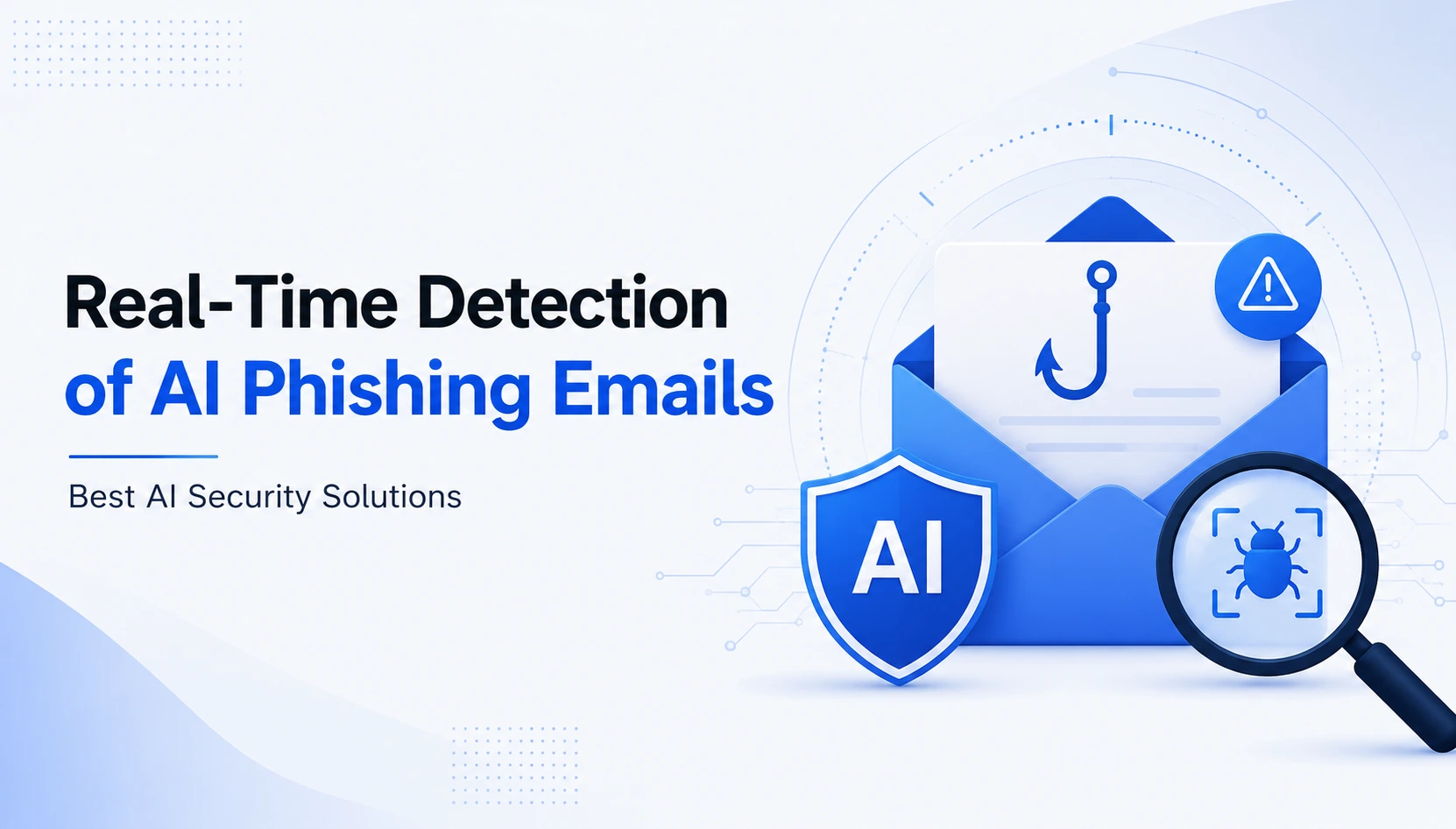
Real-time detection of AI phishing emails has become essential as cybercriminals use generative AI to create highly convincing phishing attacks. In this guide, you’ll learn how AI-powered email security works, compare leading security platforms, and discover best practices to protect your business from advanced email threats.
What Is Real-Time Detection of AI Phishing Emails?
Real-time detection of AI phishing emails uses artificial intelligence to identify and stop phishing attacks as emails enter an organization’s inbox. Unlike traditional security tools that mainly rely on known signatures or blacklists, modern email security AI platforms analyze language, sender behavior, and communication patterns to detect suspicious messages—even if they have never been seen before.
As generative AI makes phishing emails more realistic, organizations increasingly rely on AI-driven security to defend against sophisticated attacks.
Why AI-Generated Phishing Is More Dangerous
Generative AI has changed how phishing attacks are created. Instead of sending generic emails with obvious spelling mistakes, attackers can now generate highly personalized messages in seconds.
AI-generated phishing emails often:
- Use natural, fluent language.
- Mimic a company’s writing style.
- Reference real business relationships or projects.
- Create urgency to pressure recipients into acting quickly.
- Target specific employees in spear phishing or Business Email Compromise (BEC) attacks.
Because these emails appear more legitimate, they can be much harder for users—and traditional filters—to recognize.
How Real-Time AI Detection Works
Modern email security AI platforms analyze every incoming email using multiple signals instead of relying on a single detection method.
Depending on the platform, AI may evaluate:
- Writing style and language patterns using natural language processing (NLP).
- Sender behavior and communication history.
- Signs of Business Email Compromise (BEC).
- Domain reputation and authentication results.
- Unusual requests involving payments or sensitive information.
- Behavioral anomalies compared with normal business communications.
This real-time analysis allows suspicious emails to be flagged or quarantined before they reach employees, reducing the risk of successful phishing attacks.
Best AI Security Solutions for Email Phishing
Organizations need security platforms that can detect modern phishing attacks as they evolve. The following AI security solutions for email phishing combine behavioral analysis, machine learning, and cloud integrations to help identify threats that traditional filters may miss.
Abnormal Security
Abnormal Security is a cloud-native email security platform designed to protect organizations from advanced email attacks, including phishing, BEC, account takeover, and vendor fraud.
Key capabilities include:
- Behavioral AI that learns normal communication patterns.
- NLP-based email analysis.
- Business Email Compromise detection.
- API-based deployment.
- Integration with Microsoft 365 and Google Workspace.
Rather than relying only on known malicious signatures, the platform evaluates the overall context of each email to detect suspicious activity.
IRONSCALES
IRONSCALES combines AI-powered threat detection with human reporting to strengthen email security.
Its features include:
- AI-assisted phishing detection.
- Automated incident response.
- Behavioral analysis.
- Phishing simulation and security awareness training.
- Integration with Microsoft 365 and Google Workspace.
This combination helps organizations respond more quickly to emerging phishing campaigns.
Microsoft Defender for Office 365
Microsoft Defender for Office 365 provides advanced email protection for organizations using Microsoft 365.
Its security features include:
- AI-assisted phishing protection.
- Safe Links and Safe Attachments.
- Business Email Compromise detection.
- Threat investigation and automated response.
- Deep integration across the Microsoft security ecosystem.
These capabilities help security teams identify sophisticated email threats while simplifying incident management.
Darktrace
Darktrace applies self-learning AI to detect unusual behavior across enterprise environments, including email communications.
For email security, it offers:
- Behavioral threat detection.
- Real-time anomaly analysis.
- Protection against spear phishing and BEC attacks.
- Continuous learning based on organizational communication patterns.
- Integration with major cloud email platforms.
By identifying deviations from normal behavior, Darktrace can detect attacks that may not match previously known phishing techniques.
AI-Powered Email Security vs Traditional Filters
Traditional email filters remain useful for blocking known threats, but AI-powered security platforms provide additional protection against sophisticated phishing attacks that continuously evolve.
| Feature | Traditional Email Filters | AI-Powered Email Security |
|---|---|---|
| Detection Method | Signatures and blacklists | NLP and behavioral analysis |
| Zero-day AI attacks | Limited | Stronger behavioral detection |
| Business Email Compromise | Limited | Designed to detect |
| Learning Capability | Static rules | Continuous machine learning |
| Real-Time Analysis | Limited | Yes |
Traditional Secure Email Gateways (SEG)
Traditional Secure Email Gateways (SEGs) primarily rely on predefined rules and threat intelligence to stop malicious emails.
They typically examine:
- Known malicious domains.
- Blacklisted IP addresses.
- Suspicious attachments.
- Malware signatures.
- URL reputation.
While these methods remain effective against many common threats, they may struggle with highly personalized phishing emails created using generative AI.
AI-Powered Email Security Platforms
AI-powered email security platforms add another layer of protection by understanding how people normally communicate within an organization.
Instead of searching only for known threats, they analyze:
- Communication patterns.
- Writing style.
- Sender behavior.
- Relationship history.
- Context and intent.
- Signs of impersonation.
This allows them to identify suspicious emails even when attackers use new techniques or previously unseen content.
Which Approach Is Better?
For most organizations, the strongest defense combines both technologies.
Traditional email filters remain valuable for blocking malware, spam, and known threats, while AI-powered platforms provide advanced protection against sophisticated phishing campaigns, Business Email Compromise, and AI-generated social engineering attacks.
While marketers use creative AI Puns Email Subject Lines to increase engagement, attackers may also generate convincing subject lines. AI security platforms analyze context rather than relying only on keywords.
Best Practices to Prevent AI Phishing Attacks
Technology alone cannot stop every phishing attack. The most effective defense combines AI-powered security tools with strong security policies, employee awareness, and continuous monitoring. These best practices can significantly reduce the risk of successful AI-generated phishing attacks.
Enable Multi-Factor Authentication
Multi-factor authentication (MFA) adds an extra layer of security even if an attacker obtains a user’s password through phishing.
For stronger protection:
- Require MFA for all business accounts.
- Use phishing-resistant authentication methods when available, such as passkeys or hardware security keys.
- Enable conditional access policies for sensitive systems.
- Regularly review authentication logs for unusual activity.
MFA cannot stop phishing emails from arriving, but it greatly reduces the chance of account compromise after credentials are stolen.
Train Employees to Recognize AI Phishing
Modern phishing emails often look authentic, making employee awareness more important than ever.
Training should teach employees how to identify:
- Unexpected requests for payments or sensitive information.
- Urgent messages designed to create panic.
- Requests to bypass normal approval processes.
- Slightly altered sender addresses.
- Unusual communication that differs from normal business behavior.
Regular phishing simulations and security awareness programs help employees recognize evolving attack techniques.
Organizations that send legitimate outreach should also follow email best practices. Our AI Sales Email Generator guide explains how to create trustworthy business emails that support recipient confidence.
Monitor Email Behavior Continuously
AI-powered security platforms are most effective when they continuously learn from normal communication patterns.
Organizations should monitor:
- Unusual login locations.
- Changes in sender behavior.
- Abnormal communication patterns.
- Suspicious forwarding rules.
- Unexpected access to sensitive mailboxes.
Continuous monitoring enables security teams to detect potential threats before they develop into larger security incidents.
Frequently Asked Questions
Can AI detect AI-generated phishing emails?
Yes. Modern AI security platforms use technologies such as natural language processing (NLP), behavioral analysis, and machine learning to identify suspicious emails. Rather than relying only on known malicious signatures, they evaluate communication patterns, context, sender behavior, and signs of impersonation to detect sophisticated phishing attacks.
Is AI better than traditional spam filters?
AI-powered security provides stronger protection against advanced threats such as Business Email Compromise (BEC) and AI-generated spear phishing. However, traditional spam filters still play an important role in blocking known malware, spam, and malicious domains. Many organizations achieve the best results by using both approaches together.
Which AI email security solution is best?
The right solution depends on your organization’s size, email platform, and security requirements.
- Abnormal Security focuses on behavioral AI and advanced phishing detection.
- IRONSCALES combines AI detection with phishing awareness and automated response.
- Microsoft Defender for Office 365 is a strong choice for organizations already using Microsoft 365.
- Darktrace specializes in self-learning behavioral analysis across enterprise environments.
After securing your email environment, our AI Follow Up Email Generator guide can help you automate legitimate follow-up emails without compromising quality.
Final Thoughts
Real-time detection of AI phishing emails has become an essential part of modern cybersecurity. As phishing attacks grow more convincing through generative AI, organizations need security solutions that combine behavioral analysis, machine learning, and real-time threat detection to protect users before attacks succeed.
Security is especially important when communicating with new business contacts. Our Swordfish AI Email Finder review explains how to find professional contact information responsibly. If you’re setting up secure business communications, our Email Address Generator AI guide can help you create a professional email address that strengthens your organization’s credibility.
