
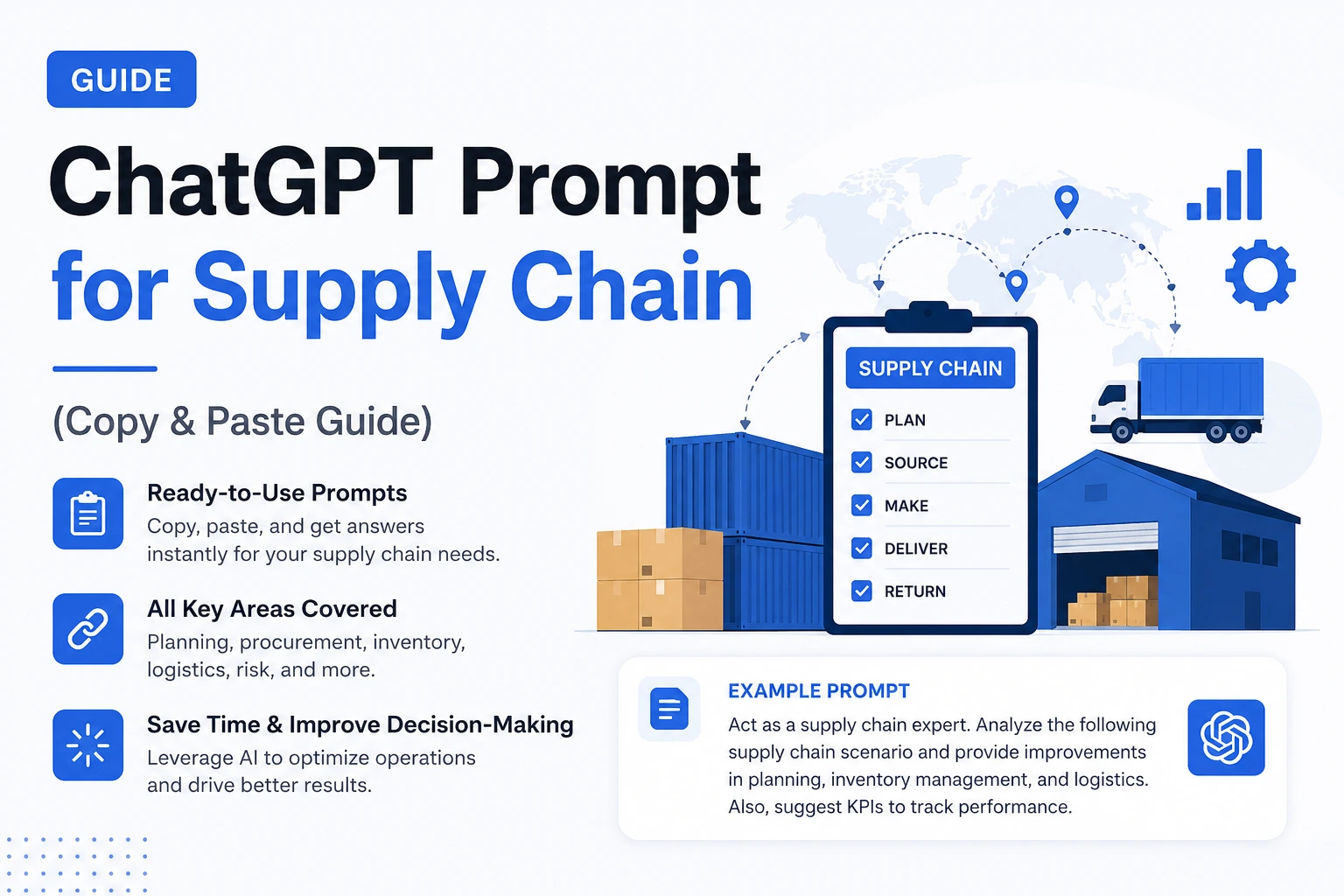
Managing a modern supply chain requires speed, accuracy, and constant decision-making across procurement, logistics, inventory, and risk management. This is where chatgpt prompt for supply chain becomes a powerful operational tool.
Instead of spending hours analyzing data or drafting reports, supply chain professionals can use structured AI prompts to generate insights, optimize processes, and respond to disruptions more efficiently.
In this guide, you’ll discover practical, copy-and-paste prompts designed to help you turn ChatGPT into a real supply chain operations assistant.
What Is a ChatGPT Prompt for Supply Chain?
A chatgpt prompt for supply chain is a structured instruction designed to help ChatGPT analyze, optimize, and support supply chain operations. Instead of using AI for general conversations, supply chain professionals can leverage specialized prompts to solve operational challenges, improve decision-making, and automate routine tasks across procurement, inventory management, logistics, and risk planning.
Whether you’re a supply chain manager, procurement specialist, logistics coordinator, or eCommerce business owner, well-designed prompts can turn ChatGPT into a valuable operational assistant that helps you work more efficiently and strategically.
How AI Supports Modern Supply Chain Management
Modern supply chains generate enormous amounts of data from suppliers, warehouses, transportation networks, and customer demand. Processing this information manually can be slow and resource-intensive.
A well-crafted chatgpt prompt for supply chain can help professionals:
- Analyze supply chain processes and identify inefficiencies
- Generate procurement and supplier communication documents
- Support demand forecasting and inventory planning
- Develop contingency plans for disruptions
- Create logistics optimization frameworks
- Summarize complex operational reports
While ChatGPT should not replace specialized ERP or forecasting software, it can significantly improve productivity by accelerating analysis, documentation, and strategic planning.
Benefits of Using ChatGPT in Supply Chain Operations
Organizations are increasingly adopting AI tools because they help reduce administrative workload and improve decision-making speed.
Some of the key benefits of using a chatgpt prompt for supply chain include:
- Faster operational analysis: Quickly evaluate workflows and identify bottlenecks.
- Improved supplier communication: Generate professional negotiation emails, RFQs, and vendor management documents.
- Enhanced inventory planning: Support stock management and replenishment strategies.
- Better risk management: Create contingency plans for supply chain disruptions and supplier failures.
- Increased efficiency: Automate repetitive documentation and reporting tasks.
- Scalable decision support: Generate recommendations that help teams respond faster to operational challenges.
By using structured prompts tailored to specific supply chain functions, businesses can transform ChatGPT from a general AI tool into a practical assistant that supports smarter and more efficient supply chain operations.
Best ChatGPT Prompt for Supply Chain (Copy & Paste)
When working with a chatgpt prompt for supply chain, the goal is not just to generate text, but to produce actionable operational insights that help managers make faster and better decisions. Below are high-quality, copy-and-paste prompts designed for real-world supply chain analysis, optimization, and problem-solving.
Supply Chain Analysis Prompt
This prompt helps you analyze the current state of your supply chain and identify inefficiencies, risks, and improvement opportunities.
Act as a senior supply chain analyst.

Analyze the following supply chain structure:

Industry: [INDUSTRY]
Products: [PRODUCT TYPE]
Suppliers: [NUMBER / LOCATIONS]
Distribution Channels: [DETAILS]
Key Challenges: [ISSUES]

Requirements:

- Break down the full supply chain flow (procurement → production → distribution)
- Identify bottlenecks and inefficiencies
- Highlight risk areas (delays, costs, supplier dependency)
- Suggest 5 actionable improvements
- Prioritize recommendations based on impact and cost
This chatgpt prompt for supply chain is ideal for gaining a clear operational overview before making strategic decisions.
Supply Chain Process Optimization Prompt
Optimizing processes is essential for reducing costs and improving efficiency across the entire chain.
Act as a supply chain optimization consultant.

Optimize the following supply chain process:

Current Process Description: [PROCESS DETAILS]

Requirements:

- Redesign the process for maximum efficiency
- Reduce lead time and operational costs
- Improve coordination between suppliers, warehouses, and logistics
- Suggest automation opportunities
- Provide a step-by-step improved workflow
- Include KPIs to measure success
This chatgpt prompt for supply chain helps organizations move from reactive operations to proactive optimization.
Supply Chain Problem-Solving Prompt
Supply chains often face disruptions such as delays, shortages, or demand spikes. This prompt helps create structured solutions.
Act as an experienced supply chain crisis manager.

We are facing the following issue:
[DESCRIBE PROBLEM: e.g., supplier delay, stock shortage, transport disruption]

Requirements:

- Diagnose the root cause of the problem
- Propose immediate short-term actions
- Suggest long-term preventive solutions
- Recommend alternative suppliers or logistics options
- Create a clear contingency action plan
This is one of the most practical chatgpt prompts for supply chain for handling real operational disruptions effectively.
Using these prompts, supply chain professionals can transform ChatGPT into a powerful operational assistant that supports analysis, optimization, and fast problem resolution across complex logistics systems.
ChatGPT Prompts for Procurement and Vendor Management
Procurement and vendor management are critical parts of any supply chain, directly impacting cost efficiency, product quality, and operational stability. A well-designed chatgpt prompt for supply chain can help procurement teams communicate more effectively with suppliers, create structured RFPs, and evaluate vendor performance with consistency and clarity.
Below are practical prompts to optimize your procurement workflow.
Supplier Negotiation Email Prompt
Negotiating with suppliers requires a balance between cost reduction and maintaining long-term relationships. This prompt helps generate professional negotiation emails.
Act as a senior procurement manager.

Write a professional supplier negotiation email.

Supplier Type: [SUPPLIER NAME / CATEGORY]
Product/Service: [DETAILS]
Current Pricing: [INFO]
Requested Change: [e.g., 5–10% cost reduction]

Requirements:

- Maintain a respectful and long-term partnership tone
- Clearly explain the reason for negotiation (volume increase, market conditions, etc.)
- Emphasize mutual benefits
- Be firm but collaborative
- Include a clear call to action for response or discussion
This is a highly effective chatgpt prompt for supply chain when managing supplier relationships and cost optimization.
Request for Proposal (RFP) Creation Prompt
A structured RFP ensures you attract the right vendors and compare offers fairly.
Act as a procurement specialist.

Create a Request for Proposal (RFP) document.

Project Type: [PROJECT / PRODUCT NEED]
Company Background: [SHORT DESCRIPTION]
Requirements: [SPECIFICATIONS]

Requirements:

- Include project overview and objectives
- Clearly define technical and commercial requirements
- Specify submission guidelines and deadlines
- Include evaluation criteria for vendors
- Use formal and professional business language
This chatgpt prompt for supply chain helps standardize vendor selection and improve procurement transparency.
Vendor Performance Evaluation Prompt
Evaluating suppliers regularly ensures quality, reliability, and cost control across the supply chain.
Act as a supply chain performance analyst.

Evaluate vendor performance based on the following data:

Vendor Details: [NAME]
Delivery Performance: [DATA]
Quality Metrics: [DATA]
Cost Efficiency: [DATA]
Communication & Responsiveness: [NOTES]

Requirements:

- Score vendor performance across key KPIs
- Identify strengths and weaknesses
- Highlight risks or concerns
- Recommend whether to continue, renegotiate, or replace vendor
- Provide actionable improvement suggestions
This is one of the most strategic chatgpt prompt for supply chain tools for maintaining a high-performing supplier network.
Using these prompts, procurement teams can transform ChatGPT into a structured procurement assistant that improves negotiation outcomes, strengthens vendor selection processes, and enhances overall supply chain efficiency.
ChatGPT Prompts for Demand Forecasting and Inventory Management
Accurate demand forecasting and efficient inventory management are essential for reducing costs and ensuring product availability. A well-structured chatgpt prompt for supply chain can help managers analyze demand trends, optimize stock levels, and prevent both shortages and overstock situations.
Below are practical prompts designed to improve forecasting and inventory control decisions.
Demand Forecasting Analysis Prompt
Predicting demand helps businesses prepare for seasonal changes, market shifts, and customer behavior patterns. This prompt helps generate structured demand insights.
Act as a supply chain demand forecasting analyst.

Analyze and forecast product demand:

Product Category: [PRODUCT TYPE]
Historical Sales Data: [DATA SUMMARY]
Market Trends: [TRENDS]
Seasonality Factors: [IF ANY]
External Influences: [PROMOTIONS / ECONOMY / EVENTS]

Requirements:

- Identify demand patterns and trends
- Estimate future demand for the next 3–12 months
- Highlight seasonal fluctuations
- Suggest key factors influencing demand changes
- Provide actionable forecasting insights
This chatgpt prompt for supply chain helps businesses anticipate demand changes and plan production more effectively.
Inventory Optimization Prompt
Efficient inventory management ensures the right balance between supply and demand while minimizing holding costs.
Act as a senior inventory management consultant.

Optimize inventory levels for:

Product List: [ITEMS]
Current Stock Levels: [DATA]
Lead Times: [SUPPLIER INFO]
Demand Patterns: [SUMMARY]

Requirements:

- Recommend optimal stock levels for each product
- Suggest reorder points and safety stock levels
- Reduce excess inventory and holding costs
- Improve stock turnover efficiency
- Provide a structured inventory management strategy
This chatgpt prompt for supply chain helps businesses maintain efficient inventory flow while avoiding unnecessary capital lock-up.
Stockout and Overstock Prevention Prompt
Preventing stock imbalances is critical for maintaining customer satisfaction and operational efficiency.
Act as a supply chain risk and inventory control specialist.

Analyze inventory risks:

Current Stock Situation: [DETAILS]
Sales Velocity: [DATA]
Supplier Lead Times: [DATA]

Requirements:

- Identify risk of stockouts and overstock situations
- Suggest preventive actions for both scenarios
- Recommend safety stock adjustments
- Propose demand-supply balancing strategies
- Create a monitoring checklist for ongoing control
This is one of the most practical chatgpt prompts for supply chain for reducing financial losses and improving availability.
Using these structured prompts, supply chain teams can turn ChatGPT into a powerful forecasting and inventory optimization assistant that improves decision-making, reduces waste, and ensures smoother operations across the entire supply chain.
ChatGPT Prompts for Supply Chain Risk Management
Risk management is a critical function in modern supply chains, where disruptions can occur due to supplier failures, logistics delays, geopolitical events, or demand shocks. A well-structured chatgpt prompt for supply chain can help managers anticipate risks, prepare contingency plans, and respond quickly to crises with minimal operational impact.
Below are essential prompts designed to strengthen supply chain resilience and risk response capabilities.
Supply Chain Disruption Contingency Plan Prompt
When disruptions occur, speed and structure matter more than anything. This prompt helps you create a clear action plan to manage unexpected issues.
Act as a senior supply chain risk management consultant.

We are facing a supply chain disruption:

Issue: [DESCRIBE PROBLEM – e.g., supplier delay, port congestion, raw material shortage]
Duration: [ESTIMATED DELAY]
Affected Products: [PRODUCTS]

Requirements:

- Analyze the root cause of the disruption
- Create an immediate response plan (0–7 days)
- Suggest medium-term mitigation actions (1–4 weeks)
- Identify alternative suppliers or logistics routes
- Outline communication strategy for internal teams and customers
- Provide a structured contingency plan with clear steps
This chatgpt prompt for supply chain is essential for maintaining operational stability during unexpected disruptions.
Supplier Risk Assessment Prompt
Evaluating supplier risk helps prevent future disruptions and ensures supply chain reliability.
Act as a procurement and risk analysis expert.

Evaluate supplier risk for:

Supplier Name: [SUPPLIER]
Category: [PRODUCT / SERVICE]
Location: [COUNTRY]

Requirements:

- Assess financial, operational, and geopolitical risks
- Evaluate delivery reliability and quality consistency
- Identify dependency risks (single-source vs multi-source)
- Assign a risk level (low, medium, high)
- Suggest risk mitigation strategies
- Recommend whether to continue, diversify, or replace supplier
This is a powerful chatgpt prompt for supply chain for building a more resilient supplier network.
Crisis Response and Mitigation Strategy Prompt
During major supply chain crises, structured decision-making is critical to minimize damage and maintain service levels.
Act as an emergency supply chain crisis manager.

Crisis Situation:
[DESCRIBE ISSUE – e.g., global shortage, transport shutdown, supplier bankruptcy]

Requirements:

- Identify immediate operational impacts
- Prioritize critical supply chain functions
- Develop short-term crisis response actions
- Suggest long-term recovery and stabilization strategy
- Provide stakeholder communication plan
- Include risk mitigation improvements for future resilience
This chatgpt prompt for supply chain helps organizations respond quickly and systematically to high-impact disruptions.
By using these structured prompts, supply chain professionals can turn ChatGPT into a proactive risk management assistant that enhances preparedness, reduces downtime, and strengthens overall supply chain resilience.
ChatGPT Prompts for Logistics and Distribution
Logistics and distribution are the backbone of any supply chain, directly impacting delivery speed, cost efficiency, and customer satisfaction. A well-structured chatgpt prompt for supply chain can help logistics managers optimize routes, evaluate third-party providers, and improve warehouse operations with data-driven decisions.
Below are essential prompts designed to enhance logistics performance and distribution efficiency.
Shipping Route Optimization Prompt
Optimizing shipping routes helps reduce transportation costs, delivery times, and fuel consumption while improving overall efficiency.
Act as a senior logistics optimization consultant.

Optimize shipping routes for the following operations:

Distribution Network: [LOCATIONS / REGIONS]
Shipment Types: [PRODUCT DETAILS]
Constraints: [COST, TIME, CARRIER LIMITATIONS]

Requirements:

- Analyze current shipping routes and identify inefficiencies
- Propose optimized routing strategies
- Reduce delivery time and transportation costs
- Suggest consolidation opportunities for shipments
- Consider cost vs speed trade-offs
- Provide a structured logistics improvement plan
This chatgpt prompt for supply chain is highly effective for improving transportation planning and reducing operational expenses.
3PL Provider Evaluation Prompt
Choosing the right third-party logistics (3PL) provider is critical for scalability and service quality.
Act as a supply chain and logistics procurement expert.

Evaluate a 3PL (Third-Party Logistics) provider based on:

Provider Details: [NAME]
Services Offered: [WAREHOUSING / TRANSPORT / FULFILLMENT]
Performance Data: [OTD, COST, ACCURACY, ETC.]

Requirements:

- Assess service quality, reliability, and scalability
- Compare cost efficiency against industry benchmarks
- Evaluate delivery performance (OTD, accuracy rates)
- Identify operational risks and limitations
- Recommend whether to continue or switch provider
- Suggest improvement areas for negotiation or optimization
This chatgpt prompt for supply chain helps businesses make informed decisions when outsourcing logistics operations.
Warehouse Efficiency Improvement Prompt
Warehouse efficiency directly affects order fulfillment speed, inventory accuracy, and operational costs.
Act as a warehouse operations optimization specialist.

Analyze and improve warehouse operations:

Current Layout and Process: [DESCRIPTION]
Inventory Volume: [DETAILS]
Order Fulfillment Challenges: [ISSUES]

Requirements:

- Identify inefficiencies in warehouse layout and workflow
- Suggest improvements in storage, picking, and packing processes
- Recommend automation or technology solutions
- Optimize labor utilization and productivity
- Reduce order processing time and errors
- Provide a step-by-step improvement plan
This is one of the most practical chatgpt prompt for supply chain use cases for improving fulfillment performance.
Using these structured prompts, logistics professionals can turn ChatGPT into a powerful operations assistant that enhances routing efficiency, strengthens 3PL management, and improves warehouse productivity across the entire supply chain network.
Advanced ChatGPT Workflow for Supply Chain Managers
A powerful chatgpt prompt for supply chain is not just a single command—it becomes significantly more effective when used as part of a structured workflow. Supply chain managers deal with complex, interconnected systems, so breaking analysis into steps helps generate more accurate insights, better decisions, and actionable strategies.
Below is a 3-step workflow designed to transform ChatGPT into a full supply chain operations assistant.
Step 1 – Supply Chain Data Analysis Prompt
The first step is to analyze raw operational data to understand the current state of the supply chain.
Act as a senior supply chain data analyst.

Analyze the following supply chain data:

Data Provided: [INVENTORY LEVELS, SALES, LEAD TIMES, SUPPLIER INFO]

Requirements:

- Summarize key operational metrics
- Identify patterns in demand, supply, and inventory flow
- Highlight inconsistencies or inefficiencies in the data
- Break down performance by suppliers, products, or regions
- Provide a structured data interpretation report
This chatgpt prompt for supply chain helps convert raw data into meaningful operational insights.
Step 2 – Bottleneck Identification Prompt
Once data is understood, the next step is identifying where delays, inefficiencies, or risks are occurring.
Act as a supply chain process optimization expert.

Based on the analyzed data:

Supply Chain Overview: [SUMMARY FROM STEP 1]

Requirements:

- Identify bottlenecks in procurement, production, inventory, or logistics
- Explain root causes of inefficiencies
- Highlight high-risk areas affecting performance
- Prioritize issues based on business impact
- Suggest initial improvement opportunities
This chatgpt prompt for supply chain ensures managers focus on the most critical operational issues first.
Step 3 – Action Plan and KPI Development Prompt
The final step is turning insights into measurable actions and performance tracking systems.
Act as a senior supply chain strategy consultant.

Based on identified bottlenecks:

Issues Summary: [FROM STEP 2]

Requirements:

- Create a detailed action plan to resolve each issue
- Assign priorities and timelines (short-term / long-term)
- Define KPIs to measure improvement (OTD, cost, efficiency, etc.)
- Suggest monitoring methods for ongoing performance tracking
- Provide a structured implementation roadmap
This is one of the most valuable chatgpt prompt for supply chain workflows for turning analysis into execution.
By following this structured 3-step approach, supply chain managers can transform ChatGPT from a simple assistant into a full operational decision-support system that improves visibility, reduces inefficiencies, and drives continuous optimization across the entire supply chain.
Common Mistakes When Using ChatGPT for Supply Chain
While a well-designed chatgpt prompt for supply chain can significantly improve decision-making and operational efficiency, many professionals still fail to get accurate or actionable results due to how they use AI. Most issues don’t come from ChatGPT itself, but from missing context, poor prompt design, or over-reliance on automation.
Below are the most common mistakes to avoid.
Relying on AI Without Real Operational Data
One of the biggest mistakes is using ChatGPT without providing real supply chain data. Without inputs like inventory levels, lead times, supplier performance, or demand history, the output becomes too generic to be useful in real operations.
Even the best chatgpt prompt for supply chain requires:
- Accurate inventory and demand data
- Supplier and logistics information
- Real constraints (cost, time, capacity)
Without this, AI can only generate theoretical suggestions rather than actionable strategies.
Ignoring Supplier and Market Variables
Supply chains are highly dynamic and influenced by external factors such as supplier reliability, geopolitical risks, and market fluctuations. Ignoring these variables leads to incomplete or unrealistic recommendations.
Effective chatgpt prompt for supply chain design must always consider:
- Supplier capacity and reliability
- Market demand changes
- Transportation and regional risks
- Cost fluctuations and availability
Failing to include these factors reduces the accuracy of any AI-generated strategy.
Using Generic Prompts for Complex Logistics Issues
Another common mistake is using overly simple prompts for highly complex logistics challenges. A generic instruction like “optimize my supply chain” will not produce meaningful insights.
Instead, chatgpt prompt for supply chain workflows should be:
- Structured in steps (analysis → bottleneck → action plan)
- Specific to the business context
- Supported by clear constraints and objectives
Complex supply chain problems require equally structured prompting to get reliable results.
Final Thoughts
Turn ChatGPT Into a Supply Chain Advisor
When used correctly, ChatGPT can act as a powerful operational advisor for supply chain professionals—supporting everything from procurement decisions to logistics optimization. However, its true value comes from structured workflows and high-quality inputs, not one-line commands.
This approach is similar to what we explored in chatgpt prompts for recruiters, where breaking down complex hiring processes into structured steps leads to far more accurate and scalable results.
Use AI Prompts to Improve Supply Chain Efficiency
By mastering chatgpt prompt for supply chain techniques, managers can reduce inefficiencies, improve visibility, and make faster, data-driven decisions across the entire supply chain. The key is to combine AI capabilities with real operational data and human expertise to build a truly optimized and resilient supply chain system.
Using a chatgpt prompt for supply chain effectively is not about replacing human expertise—it’s about enhancing it. When combined with real operational data and structured workflows, ChatGPT can significantly improve decision-making in procurement, logistics, forecasting, and risk management. However, the real advantage comes from using AI strategically rather than generically.
Professionals who integrate structured prompts into their daily operations will gain faster insights, better efficiency, and a stronger competitive edge in supply chain management.
